

How to Keep Records on Your Firearms - Inside MDT
Limiting how much personal data we surrender to any government agency, commercial entity, or social media site is always a good idea. However, gun owners need to be data collectors and record keepers. But our reasons for keeping gun data are significantly different from those who seek to control us. We must keep gun data for safety, liability, and cost-saving reasons.
If you're a handloader, you already know that a record-keeping system is as important as a handloading press. However, if you only shoot factory ammo, you should also maintain records about which ammo you've tried and how it performs in various guns. After all, without written records, all you have to rely on is your memory, which is okay if it's photographic. But I don't know of anyone with that kind of retentive ability, and I certainly don't have it. So, I write things down—and you should, too. Here's what works for me.
GETTING STARTED
Whenever a new gun (rifle, pistol, or shotgun) comes into the house, I immediately make a file folder for it. I label it by make, model and caliber. I then throw in a few blank handloading data pages I've printed at home. If I received an instruction manual with the gun, I'll put that and the warranty info into the folder as well. If I happen to see a magazine article that deals with gunsmithing or handloading for this firearm, I'll photocopy it and insert it into the folder. This file becomes the home for all the information I want to retain about the firearm.
Naturally, handloading recipes are recorded on my homemade data pages, as are the results observed, including group size, velocity and pressure observations. But I'll usually go further and snip the groups from my targets, taping them onto the back of the relevant data sheet. Doing so gives me a quick visual reference as to whether the group is strung vertically, horizontally, or is nicely round. If I try factory ammo in that gun, those results are recorded in the same way. The maximum overall length of a cartridge that will work through the magazine is also recorded. But beyond handloading recipes, I'll also record the distance from bolt face to barrel lands so I can monitor barrel throat wear.
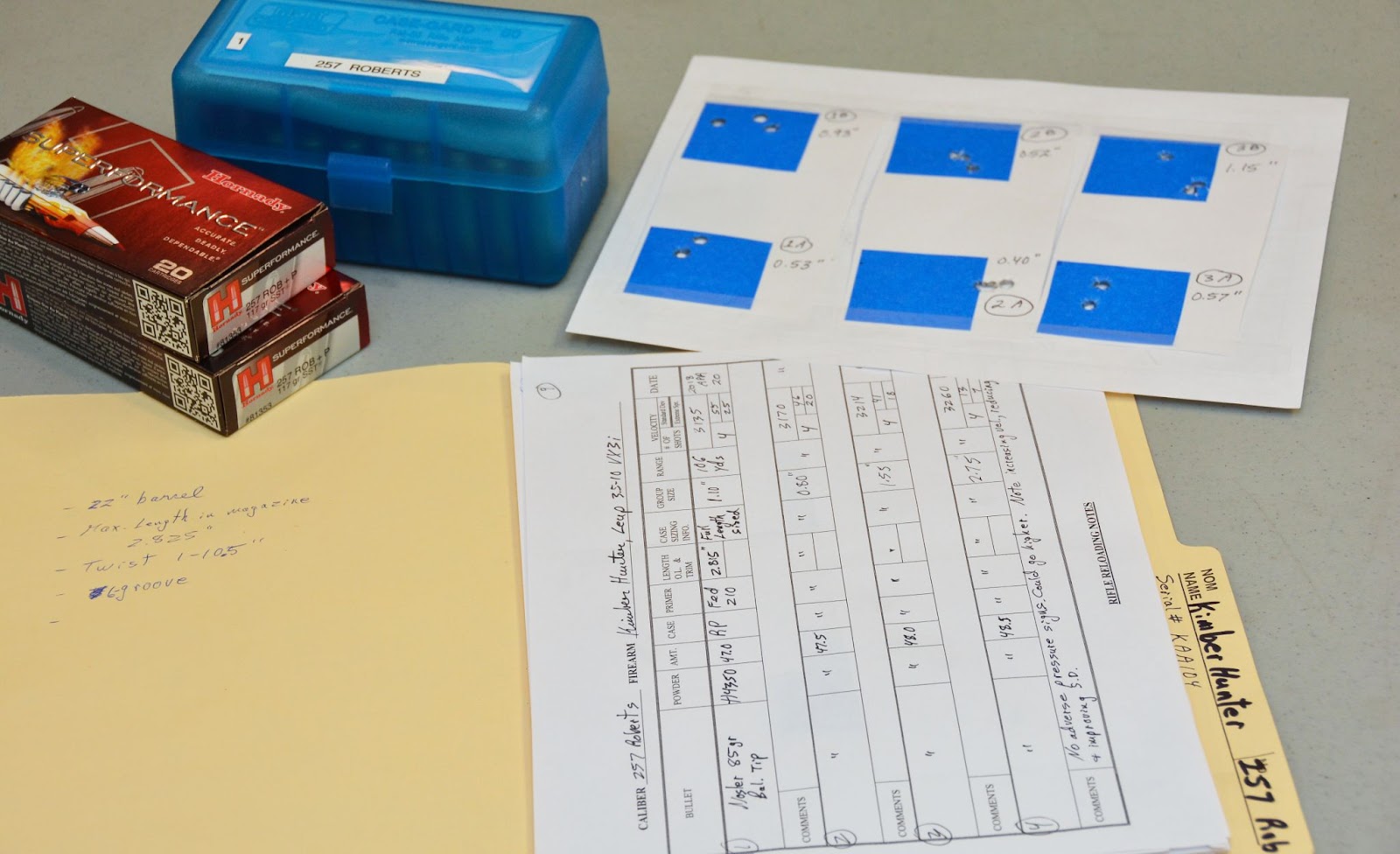
A file folder can contain all of a firearm's vital statistics and ammo history.
All this data is listed on the inside front cover of the folder, where it can be easily referenced. Each folder is then housed in a file drawer that is split in two—guns I still own and those I don't. That latter section being invaluable when another gun of the same caliber arrives, and I want to look back to see what worked and what didn't. It's a system that works for me, and if you don't have one, feel free to copy it. There are various free handloading data sheets available via an Internet search or you can create your own.
MARK AMMO BOXES
Of course, your handloading record-keeping shouldn't end at the bench. Any ammo you produce should be marked with important data like the caliber and load recipe as soon as it's boxed. Like most handloaders, I put the caliber and gun specifics on the top of the box lid and the load recipe on the inside. Inside the lid, I'll also often include how many firings brass has had since it was last annealed.
TAKE PHOTOGRAPHS
When that new-to-you gun is getting its vital statistics recorded, it is also a good time to take photographs. Images of both sides, top and bottom, and significant markings, like serial number, are all worth taking. Years ago, we'd print those photos and place them in a paper file, but in an age of digital images, I keep them in a computer file.

It's a good idea to keep a photographic record of firearms you own.
MARK YOUR FIREARMS
A couple of years ago, I started to see a pattern emerge in that I found I couldn't always remember which ammo a gun was last zeroed for—or if it was sighted in at all. After giving the matter some thought, I realized the only way to keep things straight was to mark my rifles for the ammo and distance each was sighted in for. Or as is often the case, to mark them as not zeroed at all. I started by cutting a small square of green painter's tape, writing zeroing information on it, and sticking it underneath the barrel, just in front of the forend tip. I figured this would give me a chance to see if it helped and some time to come up with a more elegant system.

It can be helpful to mark firearms with ammo and zeroing specifics.
I found the idea works just fine, and most of my guns are now marked this way. The tape adheres well enough to stay in place but can be changed easily, and when my guns are in the rack, I can see at a glance what their status is. However, I still need to find a more refined way of doing this and one I want to apply to all my rifles. Some commercial options may work for you, including Hornady's Ballistic Band, an elastic band on which you can write load data and trajectory and then attach it to the gun or even your wrist.
Don't be shy about keeping good data on your guns. Develop a system which works for your firearms and lifestyle. When it comes to firearms, collecting data and retaining it for yourself helps with safety, liability, and cost savings.
Check out the latest video from our YouTube channel!
ARTICLES FROM AL VOTH
- Common Shooting Myths
- Rimfire Season
- Optics: Parallax and Optical Center
- Optics: Understanding the Optical Triangle
- The Ethical Shot
- Avoid Common Gun Mistakes
- Hunting Drills for Success
- Pursuing Precision
- Rimfire Season
- Airgunning With MDT
- Picatinny Rails Vs Weaver Rails
ABOUT THE AUTHOR
Al Voth calls himself a "student of the gun." Retired from a 35-year career in law enforcement, including nine years on an Emergency Response Team, he now works as an editor, freelance writer, and photographer, in addition to keeping active as a consultant in the field he most recently left behind—forensic firearm examination. He is a court-qualified expert in that forensic discipline, having worked in that capacity in three countries. When he's not working these days, you'll likely find him hunting varmints and predators (the 4-legged variety).
MDT Renegade Ultra-Light Shooting Bag Wins On Target Magazine's Editor's Choice Award
#MDTSTORY - Bull Down, on the "P" Road!
Related Posts

5 Benefits of Suppressors Beyond Sound Reduction on Precision Rifles

Guns & Ammo: Savage 110 Ultralite Elite

Using a Sling in Modern Marksmanship

The Four Cornerstones of Marksmanship

Building a Classic Rifle with the MDT TIMBR CORE

Federal’s Peak Alloy Ammunition: Revolutionary Advancement or Reason for Caution?

Impact Shooting: MDT Field Stock in a Precision Rifle Match
